
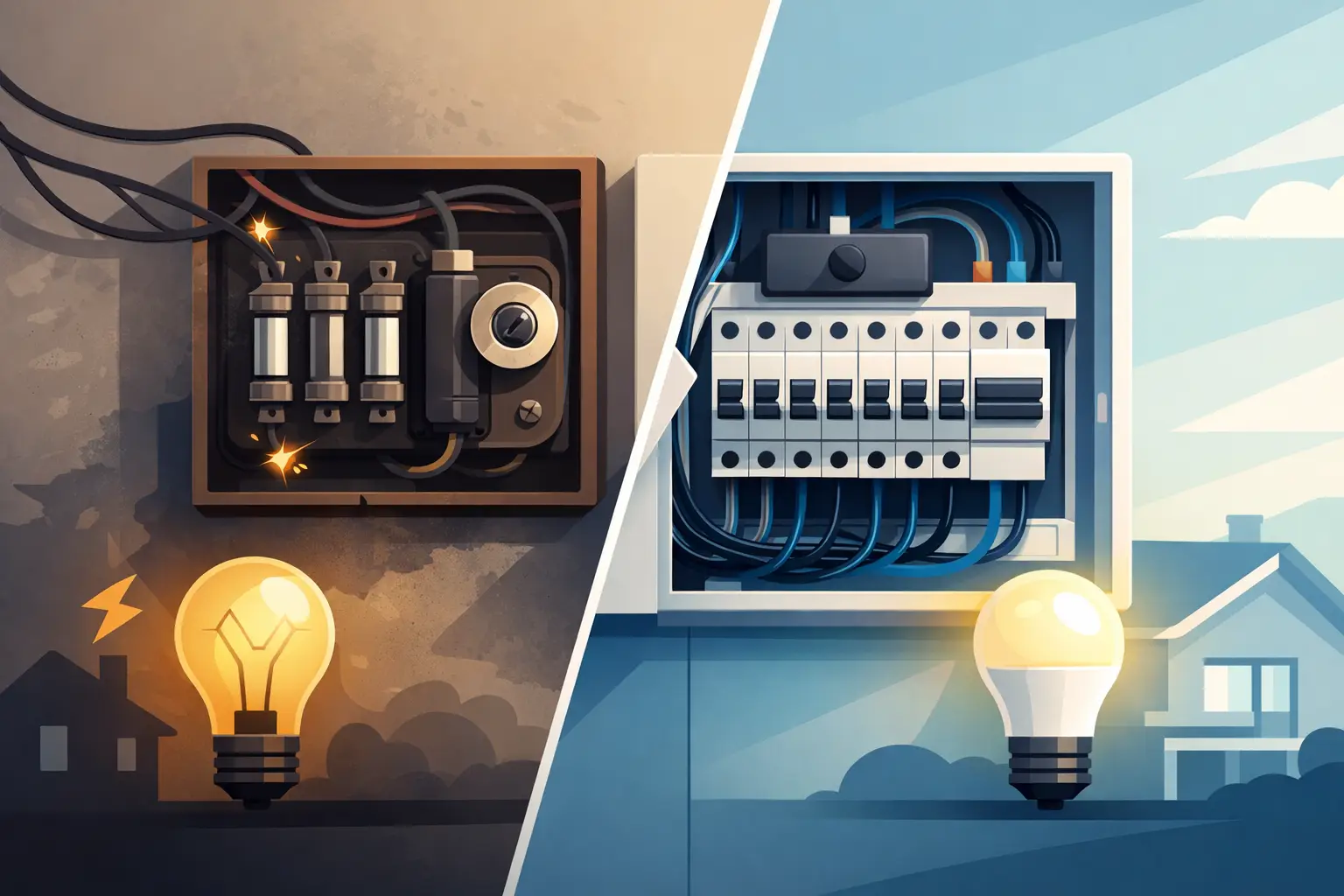
If your lights dim when the microwave starts, a fuse blows when you plug in a space heater, or your home still has screw-in fuses from decades ago, it may be time to upgrade old fuse box equipment. For many Sonoma County homeowners, this is not just about convenience. It is about safety, insurance concerns, and making sure the electrical system can support how people actually live now.
Why homeowners upgrade old fuse box systems
Older fuse boxes were built for a different era. Homes had fewer appliances, no EV chargers, fewer kitchen circuits, and far less demand overall. A fuse box may have worked fine when the house was built, but modern life puts a lot more strain on the system.
That does not mean every old fuse box is automatically dangerous. Some older systems have operated for years without obvious issues. The problem is that age, wear, outdated design, and added electrical demand can create conditions where the system is no longer a good fit for the home.
A fuse box also works differently than a modern breaker panel. When a fuse blows, it must be replaced. That often leads homeowners to install the wrong size fuse or use temporary workarounds, which can defeat the safety protection the system is supposed to provide. That is where real risk starts to grow.
Signs it may be time to upgrade an old fuse box
Some warning signs are obvious, and some are easy to ignore until they become expensive. If your home still has a fuse box and you are noticing repeated electrical problems, it is worth having the system evaluated by a licensed electrician.
Frequent blown fuses are one of the clearest signs. So are flickering lights, warm outlets, buzzing sounds, or circuits that cannot handle normal household use. If you rely on extension cords because there are not enough usable outlets, that can also point to an older system that no longer matches the home’s needs.
Another common issue is renovation plans. If you want to add recessed lighting, install a hot tub circuit, upgrade kitchen appliances, or set up a Level 2 EV charger, an old fuse box may not have the capacity or layout to support the work safely.
There is also the insurance factor. Some insurance carriers are hesitant to cover homes with outdated electrical equipment, or they may require replacement before issuing or renewing a policy. If you are buying, selling, or refinancing a home, that can move a fuse box upgrade from a someday project to an immediate one.
Safety concerns with older fuse boxes
The main job of any electrical panel is to protect the home from overloads and short circuits. When that protection is outdated, damaged, or misused, the risk of overheating and fire goes up.
One of the biggest concerns with older fuse boxes is over-fusing. That happens when someone installs a fuse with a higher amperage rating than the circuit wiring can safely handle. Instead of the fuse blowing when the circuit is overloaded, the wires can overheat behind the walls.
Aging connections are another issue. Corrosion, loose terminals, heat damage, and general wear can all affect performance. You may not see those problems from the outside, but a licensed electrician can identify them during an inspection.
It also matters that many older systems were not designed with modern grounding and safety standards in mind. Even if the fuse box appears to be functioning, it may fall short of what a homeowner should expect from a safe, dependable residential electrical system today.
Fuse box vs. breaker panel
For most homeowners, the practical replacement for a fuse box is a modern breaker panel. Breakers trip instead of blowing, and they can be reset after the issue is addressed. More importantly, modern panels are built to support today’s electrical loads and allow for safer expansion when you add circuits in the future.
That matters if your home is evolving. A panel upgrade can create room for EV charging, air conditioning, electric dryers, induction cooking, garage circuits, or outdoor improvements without forcing the electrical system to operate at its limit.
A new panel also gives a homeowner clearer circuit organization. That makes troubleshooting easier and helps reduce the patchwork electrical changes that often accumulate in older homes over time.
What happens during a fuse box upgrade
When professionals upgrade old fuse box equipment, the job usually involves more than swapping one box for another. The electrician will first evaluate the service size, existing wiring, grounding, and the overall condition of the electrical system. In some homes, the wiring is in good enough shape to work with a new panel. In others, additional repairs or code-related improvements may be needed.
The work often includes replacing the fuse box with a breaker panel, updating grounding and bonding, labeling circuits properly, and coordinating utility disconnect and reconnection as needed. Permits and inspections are also part of a legitimate panel replacement.
That last point matters. Electrical panel work is not a handyman project. It involves the main service to the home, and mistakes can create serious safety hazards. A licensed residential electrician should handle diagnosis, permitting, installation, and testing.
How much it costs to upgrade an old fuse box
Cost depends on the home, the service size, and what else the project uncovers. A straightforward replacement is different from a full service upgrade that includes a new meter base, grounding improvements, or repairs to damaged wiring.
For that reason, there is no honest one-price-fits-all answer. Homeowners should be cautious of quotes that sound unusually low before anyone has inspected the system. In electrical work, low bids sometimes leave out important code updates or quality materials.
A better approach is to get a clear evaluation and understand what is actually included. The cheapest quote is not always the best value if it ignores long-term reliability or cuts corners on components and workmanship.
Is upgrading always necessary?
Sometimes yes, sometimes not. If a fuse box is in poor condition, overloaded, or blocking needed upgrades, replacement is usually the right move. If the home has active safety concerns or insurance requirements, delaying can become more costly than addressing it now.
On the other hand, not every older home needs a major electrical overhaul all at once. A trustworthy electrician should explain what is urgent, what is recommended, and what can reasonably wait. That kind of honest guidance matters, especially when homeowners are trying to make smart budget decisions.
For example, a homeowner planning to install an EV charger may need a panel upgrade sooner than a homeowner with modest electrical usage and no expansion plans. The right answer depends on the condition of the existing equipment and what the home needs next.
Why local experience matters in Sonoma County
Older homes are common throughout Santa Rosa and the surrounding Sonoma County area, and older homes often come with layers of electrical history. Some have partial upgrades. Some have additions wired at different times. Some have hidden issues that only show up when a panel is opened and tested.
That is why experience with residential electrical service matters. A qualified local electrician can spot signs of prior modifications, understand permitting expectations, and recommend a solution that fits both the home and the homeowner’s goals.
At APG Electric Co., the focus is on giving homeowners clear answers, safe workmanship, and practical recommendations without unnecessary upselling. That is especially important with panel and fuse box work, where trust matters as much as technical skill.
What to do next if your home still has a fuse box
If your home still runs on fuses, the smartest next step is not guessing. It is getting the system inspected by a licensed professional who works on residential service equipment regularly. A good evaluation can tell you whether the fuse box is simply old, actively unsafe, or standing in the way of upgrades you already have planned.
A fuse box does not always fail dramatically before it becomes a problem. Sometimes it just quietly falls behind the demands of the home. Getting ahead of that now can make your electrical system safer, more reliable, and better prepared for the way you actually live.