935 Bush Street Santa Rosa, CA 95404
License #998700
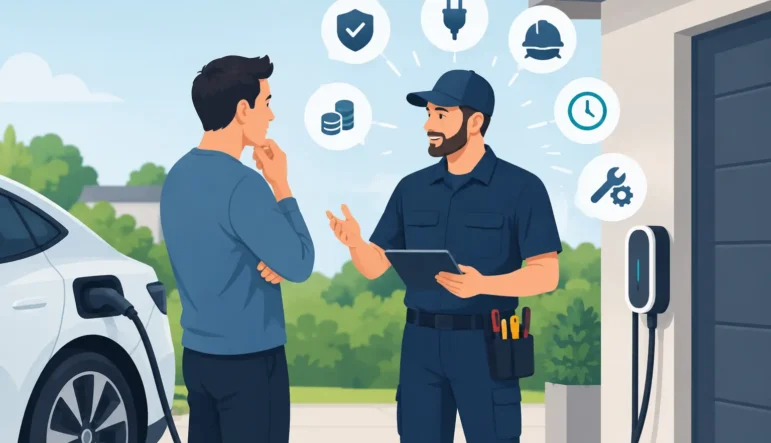
A home EV charger should make daily driving easier, not create uncertainty about your electrical system. Before approving an installation, homeowners should know the right questions to ask an EV electrician. The answers can reveal whether your home is ready for charging, what upgrades may be needed, and whether the quote accounts for safe, code-compliant work from the start.
A quality installation is about more than mounting a charging unit in the garage. It involves your electrical panel, available capacity, wiring route, permit requirements, charger settings, and the condition of the home itself. Asking a few direct questions before work begins helps you compare electricians on more than price alone.
Start with credentials. California homeowners should hire a properly licensed electrical contractor for EV charging work, not a handyman or an installer whose experience is limited to mounting the charger hardware.
Ask how often the electrician installs Level 2 chargers in homes like yours. A residential electrician who regularly evaluates panels, runs dedicated circuits, and handles local permits will be better prepared to spot issues before they become change orders or delays. Experience also matters when your home has an older panel, a detached garage, or a long run from the panel to the charging location.
This is one of the most important questions on the list. A Level 2 charger can add a meaningful continuous electrical load, commonly 32, 40, 48, or more amps depending on the charger and vehicle. Your electrical panel may have open breaker spaces but still lack sufficient capacity for another major load.
A qualified electrician should evaluate your service and calculate the home’s electrical demand. They should account for existing equipment such as air conditioning, electric heat, a heat pump, electric range, dryer, hot tub, pool equipment, solar, and battery storage. Do not accept a simple visual glance at the panel as a substitute for a real capacity assessment.
The honest answer may be no. Many Sonoma County homes can support EV charging without a full panel replacement, especially when the existing panel is in good condition and has adequate service capacity. A trustworthy electrician should explain why an upgrade is or is not recommended.
In some cases, a panel upgrade is the right long-term choice. If the panel is outdated, overloaded, damaged, full, or undersized for the home’s growing electrical needs, installing a charger can bring that limitation to light. In other cases, a subpanel, load-management device, or a lower-amperage charging setup may be a more cost-conscious solution. Ask the electrician to walk you through the options and trade-offs instead of treating a panel upgrade as automatic.
Not every EV charges at the same rate, and not every home should be wired for the largest available charger. Your vehicle’s onboard charging capacity sets one limit. Your electrical service, panel capacity, charger location, and budget may set others.
Ask what amperage they recommend and why. A 40-amp circuit may be more than enough for an owner who drives modest daily mileage and charges overnight. A larger circuit may make sense for a household with multiple EVs, a high-mileage commute, or limited overnight charging time. The right recommendation should match how you actually use your vehicle, not simply pursue the highest number on the charger box.
Both methods can be appropriate, but they are not interchangeable. A hardwired charger is permanently connected to its dedicated circuit and is often preferred for higher-amperage charging. It eliminates the outlet and plug connection, which can be a point of wear or heat if components are poor quality or improperly installed.
A plug-in charger can offer flexibility if you may take the unit with you later, but it requires the correct receptacle, circuit rating, and installation quality. Ask which option best fits your charger, intended amperage, and future plans. If an outlet is recommended, ask what grade of receptacle will be used. This is not a place for low-cost components.
It should. EV chargers are continuous loads, meaning they can draw substantial power for hours at a time. The charger needs properly sized wiring, a correctly rated breaker, and a dedicated circuit designed for that specific load.
Ask the electrician to confirm the circuit size, expected charging output, and how the installation will meet current electrical code requirements. They should also explain whether ground-fault protection, disconnecting means, or other protections are required for your particular installation.
The closest location to the electrical panel is not always the best location for daily use. Think about where you park, where the charge port sits on your vehicle, the length and handling of the charging cable, weather exposure, and whether another vehicle may need access in the future.
Ask the electrician to assess the route before providing a final recommendation. Garage walls, exterior walls, carports, detached garages, and driveways all present different installation challenges. A clean, protected wiring route may cost more than a shortcut, but it generally looks better and holds up better over time.
EV charger installations commonly require permits, and requirements can vary by jurisdiction. A permit is not unnecessary paperwork. It creates a documented review of the work and helps confirm that the wiring, breaker, grounding, and equipment installation meet applicable safety standards.
Ask who handles the permit, whether permit fees are included in the estimate, and how the final inspection process works. An electrician should be able to explain this clearly before work begins. If someone suggests skipping required permits to save money, consider that a warning sign.
A low quote can leave out details that matter. Ask for an itemized explanation of what is included: labor, breaker, wire, conduit, receptacle or hardwire connection, charger mounting, permit fees, inspection coordination, patching if applicable, and cleanup.
Also ask what site conditions could affect the final cost. Longer wire runs, difficult attic or crawlspace access, trenching, panel repairs, drywall work, and service upgrades can change the scope. Clear pricing does not mean every possibility can be predicted before walls are opened. It means the electrician explains likely variables honestly and gets approval before moving forward with additional work.
An EV charger installation is expected to carry high electrical demand repeatedly over many years. Quality breakers, correctly sized copper conductors, listed connectors, durable conduit, and properly rated receptacles all matter.
Ask whether the electrician uses components listed for their intended purpose and compatible with your panel. The cheapest material choice is rarely the best value when it involves a continuous-load circuit. Good workmanship and premium components help reduce the chance of nuisance tripping, overheated connections, and premature repairs.
Many homeowners buy a charger before calling an electrician, and that is often fine. Still, provide the model information in advance. The electrician should verify the unit’s electrical requirements, whether it is hardwired or plug-in, its maximum output, and the manufacturer’s installation instructions.
If you have not selected a charger yet, ask for guidance based on your vehicle, available capacity, Wi-Fi needs, utility rate plans, and desired features. The best charger is not necessarily the most expensive one. It is the one that fits the home and the way you charge.
Ask what workmanship is covered and what happens if you notice a problem after the installation is complete. The electrician should distinguish between their labor warranty and the charger manufacturer’s product warranty.
It is also helpful to ask who to call if the charger trips a breaker, displays an error, or stops charging. A responsive local electrician can diagnose whether the issue is related to the charger, the vehicle, the circuit, or the home’s electrical system. APG Electric believes homeowners deserve that clarity, along with recommendations that solve the actual problem without unnecessary upselling.
The right electrician will not pressure you into the biggest charger, the largest panel upgrade, or a rushed decision. They will assess the home, explain the electrical requirements in plain language, and give you a clear path forward. That may be a straightforward dedicated circuit, or it may involve a panel upgrade because the home genuinely needs one.
Choose an electrician who welcomes your questions, documents the scope, uses quality materials, and treats safety as part of the job rather than an added feature. A properly planned EV charger installation gives you dependable charging at home and confidence every time you plug in.
