
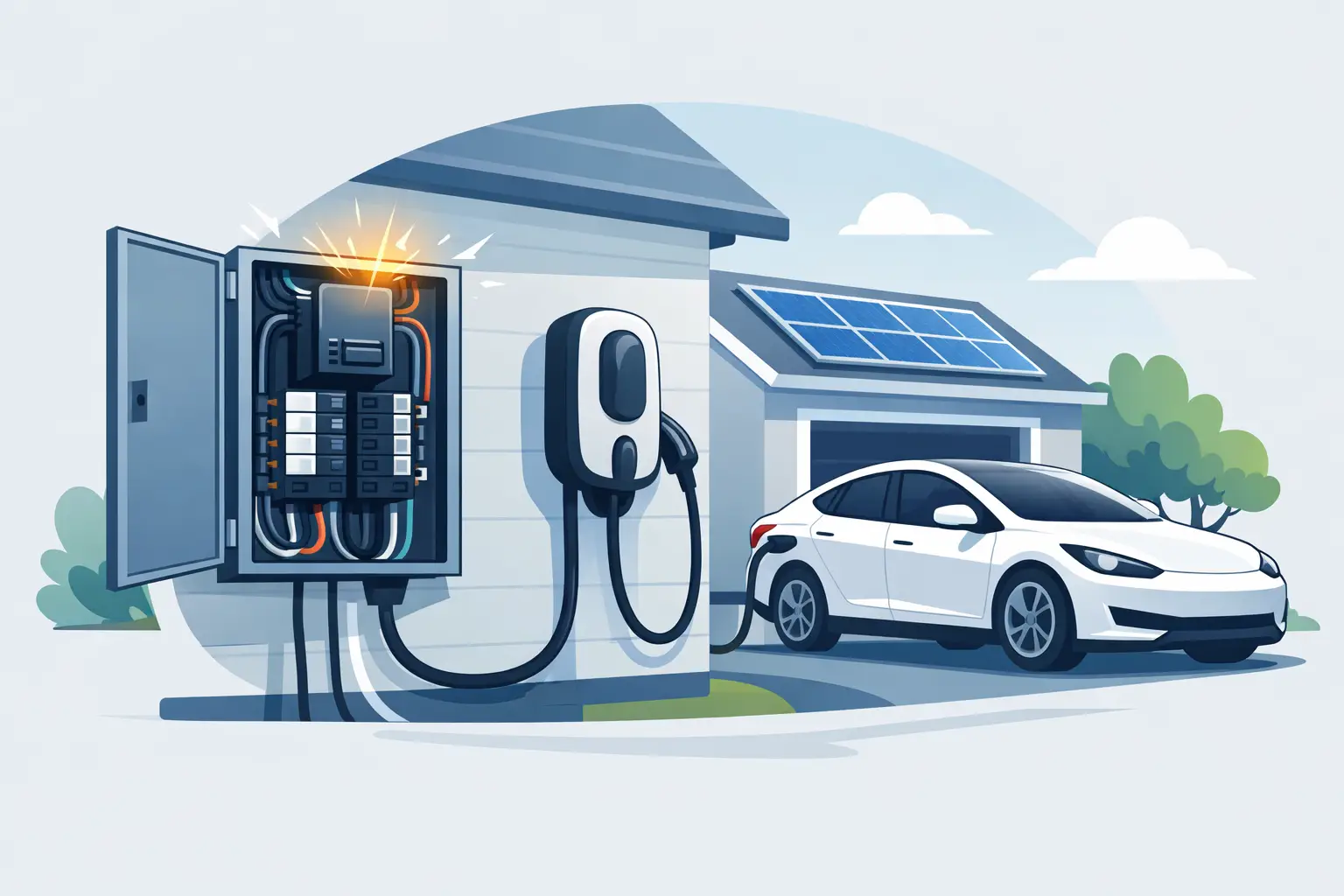
A new EV charger can expose a limitation that has been quietly sitting behind your garage wall for decades: your home may not have enough electrical capacity to add a large continuous load safely. This panel upgrade for EV charger example shows how a licensed electrician evaluates the home first, then recommends only the work needed for reliable charging.
A panel upgrade for an EV charger example
Consider a Santa Rosa homeowner with a 1960s home, a 100-amp electrical service, and a Level 2 charger planned for the garage. The homeowner drives an EV daily and wants to install a charger capable of delivering 48 amps, which is a common choice for faster overnight charging.
The charger itself is not simply treated as a 48-amp appliance. EV charging is considered a continuous electrical load because it can operate for several hours at a time. That means the circuit and the home’s electrical system must be sized with additional capacity in mind. A 48-amp charger typically requires a 60-amp dedicated circuit.
On paper, a 100-amp panel may appear to have open breaker spaces. That does not automatically mean it can support a new 60-amp circuit. Empty spaces are not the same thing as available service capacity. Before any installation, the electrician performs a load calculation to determine how much electricity the home is expected to use under applicable electrical requirements.
In this example, the home already has central air conditioning, an electric dryer, an electric range, a dishwasher, a microwave, and several smaller household loads. The load calculation shows that adding the planned 48-amp charger would push the service beyond a comfortable and code-compliant capacity. The appropriate recommendation is a 200-amp service and panel upgrade before installing the charger.
The result is not just a faster charger. The homeowner gets a modern panel with room for future circuits, a correctly sized EV charging circuit, and an electrical system better prepared for additional upgrades such as heat-pump equipment, induction cooking, or a hot tub.
What the upgrade may include
A panel upgrade can mean different things depending on the existing equipment. In the example above, the work may include replacing the old main panel, upgrading service equipment, installing a new 200-amp main breaker panel, adding the dedicated EV circuit, and coordinating any utility-side work required for the service change.
It may also involve bringing grounding and bonding components up to current requirements, replacing deteriorated wiring near the panel, installing a new meter main, or relocating equipment if clearance rules and the home’s layout require it. Permit and inspection requirements are part of the process, not an optional extra. They help verify that the system is safe for the new load and documented correctly for the home.
A professional estimate should clearly separate the work needed for the panel or service upgrade from the EV charger installation itself. That gives homeowners a clearer picture of what they are paying for and why.
Why the existing panel matters
Age alone does not always require replacement. Some older panels remain serviceable, while others have known reliability concerns, corrosion, damaged breakers, overheating signs, or limited capacity. The panel’s manufacturer, condition, available spaces, breaker configuration, and service rating all matter.
A licensed electrician should inspect the actual equipment rather than making a recommendation based only on a photo or a homeowner’s estimate of the panel size. A proper assessment also looks for warning signs such as a warm panel cover, flickering lights when large appliances start, tripped breakers, rust around the panel, or double-tapped breakers. These issues can affect the scope of the work even if the EV charger itself is modestly sized.
When a full service upgrade may not be necessary
Not every EV owner with a 100-amp panel needs to move to 200 amps. The right answer depends on the home’s calculated electrical demand, the desired charging speed, and the condition of the existing system.
For example, a homeowner who drives fewer miles each day may be well served by a 32-amp or 40-amp Level 2 charger. That lower charging rate can still add substantial range overnight while requiring less electrical capacity. In some cases, adjusting the charger’s output is a practical, cost-conscious alternative to a major service upgrade.
Load-management equipment can also be an option for certain homes. These systems monitor electrical demand and reduce or pause EV charging when the home is approaching its service limit. They can be useful where upgrading the service would be especially complex, but they need to be designed and installed correctly. They are not a shortcut for an overloaded or unsafe panel.
A subpanel is another term homeowners often hear. A subpanel can add breaker space in a garage or another area of the home, making it convenient to serve an EV charger. But it does not increase the total capacity of the electrical service. If the load calculation shows that the service is already at its limit, adding a subpanel alone does not solve the problem.
What affects panel upgrade cost for EV charging
There is no honest one-price answer because the scope can vary significantly from house to house. A simple panel replacement in an accessible location is very different from a full service upgrade involving a meter relocation, underground service conductors, stucco repair, or utility coordination.
The charger location also matters. A garage wall near the panel is generally simpler than a detached garage or a charger location requiring a long trench, conduit run, or difficult attic access. The charger’s selected amperage, the need for a new subpanel, local permitting requirements, and the condition of existing wiring can all affect the final estimate.
Homeowners should be cautious with estimates that promise a panel upgrade based only on the number of breaker spaces. An accurate quote begins with an on-site evaluation, a review of the existing service, and a load calculation. That approach may take more care upfront, but it helps prevent expensive changes after work has started.
Choosing the charger after the electrical evaluation
It is easy to choose a charger based on its maximum advertised output, but the highest output is not always the best value. The best charging setup matches the vehicle, daily driving needs, electrical capacity, and future plans for the home.
If a vehicle is parked for 10 to 12 hours most nights, a lower-powered Level 2 charger may provide more than enough energy. On the other hand, a household with two EVs, long daily commutes, or limited overnight parking time may benefit from higher charging capacity and a panel upgrade that leaves room for a second charger later.
This is where an electrician’s recommendation should be practical rather than one-size-fits-all. The goal is not to sell the largest panel or charger available. It is to install a safe system that meets the homeowner’s real needs without creating avoidable costs.
Questions to ask before approving the work
Before moving forward, ask whether the estimate includes a load calculation, permit, inspection, the EV circuit, and any utility coordination. It is also reasonable to ask whether the recommended panel size supports likely future projects, especially if you may add electric heating and cooling, solar, battery storage, or another EV.
Ask where the charger will be installed and how the wiring will be protected. A clean installation should account for conduit routing, garage use, weather exposure where applicable, and the charger manufacturer’s requirements. The finished work should be safe, accessible, and built with quality components that hold up over time.
For Sonoma County homeowners, APG Electric can assess the existing panel, explain the available options clearly, and provide an EV charging recommendation based on the home rather than a generic package. A careful evaluation now can make your daily charging routine easy while keeping the rest of your home’s electrical system ready for what comes next.