935 Bush Street Santa Rosa, CA 95404
License #998700
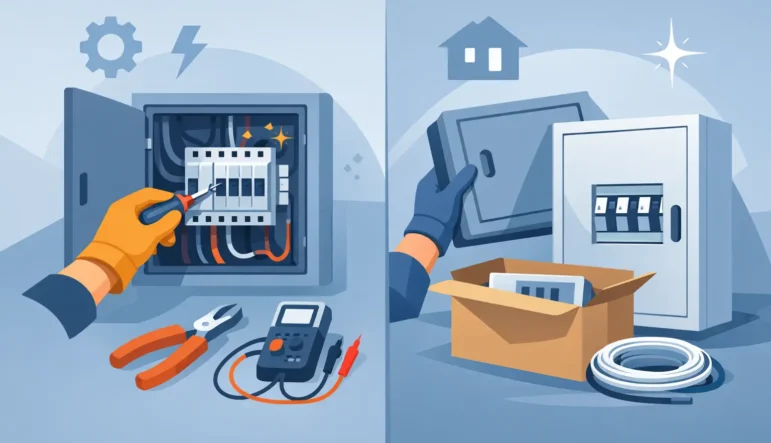
A breaker that trips once after a space heater runs is not automatically a reason to replace your electrical panel. But a panel that feels warm, makes crackling sounds, shows corrosion, or cannot support an EV charger deserves prompt attention. For Santa Rosa and Sonoma County homeowners, electrical panel repair vs replacement comes down to an accurate diagnosis – not a one-size-fits-all recommendation.
Your panel is the distribution point for nearly every electrical system in your home. It directs power to lighting, appliances, outlets, HVAC equipment, and newer additions such as EV chargers or hot tubs. When it has a problem, the safest and most cost-conscious solution depends on what is actually failing, how old the equipment is, and what your home needs next.
Repair can be the right choice when the panel enclosure, bus bars, and main components are in good condition and the issue is isolated. A licensed electrician may be able to replace a worn breaker, correct a loose connection, repair damaged wiring, add a properly sized circuit, or resolve a labeling issue without replacing the entire panel.
For example, a single breaker that trips repeatedly may be overloaded, defective, or serving a circuit with a wiring problem. Replacing that breaker without finding the cause can leave the underlying issue unresolved. A careful diagnosis identifies whether the problem is the breaker, the circuit, an appliance, or the amount of electrical load being used.
Repair is also often appropriate after minor damage from a loose neutral connection, a failed breaker, or an improperly installed circuit. In these situations, preserving a sound existing panel can be a practical decision that controls cost while restoring safe operation.
That said, repair is not the low-cost answer in every case. Repeated repairs on aging or unsuitable equipment can become more expensive than addressing the real problem once. The goal should be safe, reliable service – not simply the smallest immediate invoice.
A panel replacement is usually recommended when the equipment itself is unsafe, obsolete, damaged beyond a reliable repair, or too small for the home’s electrical demands. Some warning signs require urgent professional evaluation, especially if you notice heat, odors, or visible damage.
Consider scheduling an inspection promptly if you see any of these conditions:
A replacement may also be the best route if a home still uses fuses, has an undersized service, or needs major electrical additions. Modern households use more power than many homes were designed to provide. Central air conditioning, electric heat pumps, induction ranges, workshop equipment, pool systems, hot tubs, and EV charging can add substantial demand.
The decision often becomes clearer when you look at upcoming projects. If you are installing one new light fixture or replacing a bathroom outlet, a panel upgrade may not be necessary. If you are planning an EV charger, adding a hot tub circuit, remodeling a kitchen, or moving toward electric appliances, your available panel capacity becomes much more important.
An EV charger does not automatically require a new panel. A licensed electrician can perform a load calculation to determine whether your existing service and panel can safely support the charger alongside the rest of your home’s electrical use. Sometimes there is adequate capacity and space for a dedicated circuit. Other times, the panel needs an upgrade, a service change, or a carefully planned load-management solution.
This is where an honest assessment matters. Homeowners should not be pushed into a full replacement when a properly designed repair or circuit addition will safely meet their needs. At the same time, delaying a necessary upgrade can limit future projects and create avoidable safety concerns.
Older does not always mean unsafe. A well-maintained panel can continue to serve a home reliably if it is correctly sized, uses appropriate components, and shows no signs of deterioration. Conversely, a newer panel can have problems if it was installed poorly, exposed to moisture, overloaded, or altered without proper workmanship.
The best evaluation looks beyond the panel’s age. An electrician should inspect the condition of the breakers, connections, wiring, grounding and bonding, available circuit spaces, load demand, and the service equipment feeding the panel. The home’s renovation history also matters. Additions, garage conversions, solar equipment, and past do-it-yourself work can all affect what the electrical system needs today.
In Sonoma County, homes range from older properties with original electrical infrastructure to recently remodeled homes with high-demand equipment. The right recommendation should reflect the specific home, not a generic rule based on its year built.
A useful panel assessment gives you clear answers, not vague warnings. You should understand what is wrong, why it matters, and whether repair will provide a dependable long-term solution. If replacement is recommended, the electrician should explain what the new panel solves and how it supports your household’s current and planned electrical use.
For a replacement, the scope may include a new panel, properly sized breakers, updated grounding and bonding, circuit organization, labeling, permit coordination, and any service-related work required for the project. The exact scope depends on the existing system and local requirements.
For a repair, ask what caused the failure and whether the repair addresses that cause. A new breaker may solve a defective component. It will not solve overloaded wiring, water intrusion, or a loose connection elsewhere in the system. Clear communication at this stage protects both your budget and your home.
Some electrical concerns can be scheduled around a future remodel. Others should be treated as a priority. Shut off power to the affected area if it can be done safely and contact a licensed electrician promptly if your panel has a burning odor, visible arcing, smoke, unusual heat, water intrusion, or repeated unexplained tripping.
Avoid removing the panel cover or attempting breaker repairs yourself. Even when the main breaker is switched off, parts of the electrical equipment may remain energized. Panel work requires the right training, testing equipment, and safety procedures.
APG Electric helps homeowners make practical decisions based on the condition of their equipment, their safety needs, and the projects they have planned. Whether the answer is a targeted repair or a full panel replacement, the right next step is a clear diagnosis from a licensed professional who will explain the options plainly.
If your panel has been giving you warning signs or you are planning an EV charger, hot tub, or major home upgrade, schedule an evaluation before a small limitation becomes an expensive interruption.
