
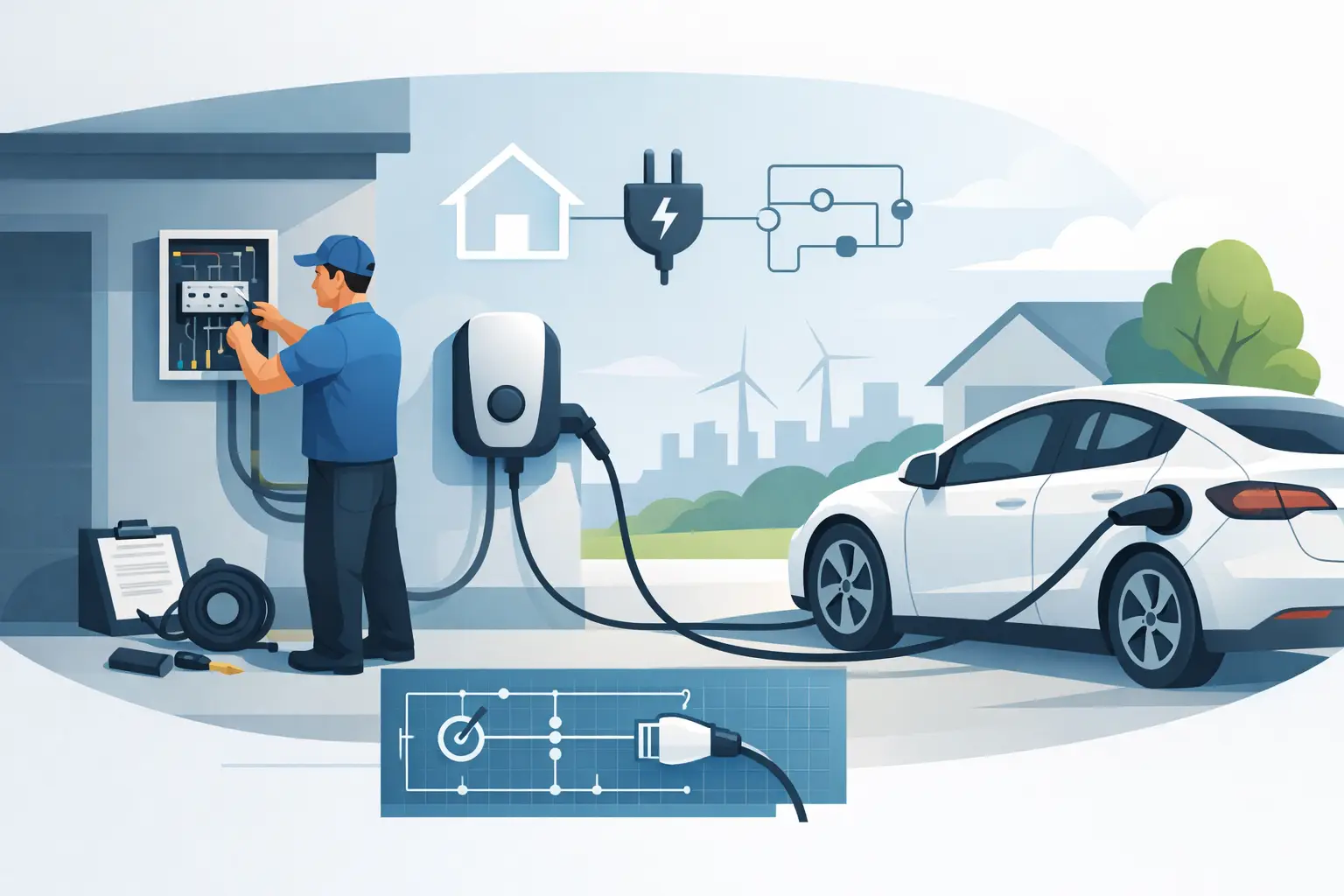
A home charging circuit installation guide should start with one practical question: can your electrical system safely support the charger you want to use every night? The charger may mount neatly in the garage, but the real work happens behind the walls and inside the electrical panel. A properly planned installation protects your home, charges your vehicle reliably, and avoids spending money on equipment that your current service cannot support.
For most EV owners, home charging is a major convenience. You arrive home, plug in, and wake up with the range you need. Getting there safely requires more than adding a 240-volt outlet. A licensed electrician should evaluate the home’s electrical capacity, charging needs, panel condition, equipment location, and local permit requirements before recommending a circuit.
Start With Your Vehicle and Charging Habits
The right circuit size depends on the vehicle, the charging equipment, and how quickly you actually need to recharge. Many homeowners choose Level 2 charging because it operates on 240 volts and delivers considerably more range per hour than a standard 120-volt outlet.
That does not automatically mean every home needs the largest available charger. If you drive modest daily distances and park overnight for 10 to 12 hours, a lower-amperage Level 2 charger may meet your needs comfortably. It can also reduce installation cost if it avoids a panel upgrade or a long, difficult wiring route.
Your vehicle’s onboard charger sets a limit on how much power it can accept. The charging station also has a maximum output rating. An electrician will look at both figures rather than assuming a higher-rated circuit will make every vehicle charge faster. This is one reason a site visit is more useful than choosing equipment based on a product listing alone.
Why EV Charging Requires a Dedicated Circuit
An EV charger is a continuous electrical load. In plain terms, it can draw significant power for several hours at a time, often while other household loads are active. The circuit serving it must be dedicated to the charging equipment and sized according to applicable electrical code.
Continuous-load rules affect the relationship between charger output and circuit rating. For example, a charger set to deliver 32 amps generally requires a 40-amp circuit. A charger delivering 40 amps generally requires a 50-amp circuit. The breaker, wire size, terminals, disconnecting means where required, and charger settings must all work together.
This is not an area for adapting an existing dryer outlet, using an extension cord, or installing an oversized breaker to stop nuisance tripping. Those shortcuts can create overheating and fire risks, damage equipment, and complicate an inspection or insurance claim. A dedicated circuit is designed for the load instead of asking an older branch circuit to do a job it was never intended to handle.
The Electrical Panel Is Often the Deciding Factor
Before installing a charging circuit, a licensed electrician performs a load calculation. This review considers the home’s service size and the electrical demand created by major appliances and systems. Electric heat, air conditioning, electric water heating, induction cooking, a hot tub, solar equipment, and a second EV can all affect the available capacity.
A panel with open breaker spaces is not necessarily a panel with enough available capacity. Conversely, a home with a smaller or older panel may still have workable options. The answer depends on the calculation, the condition of the equipment, and the design of the installation.
When a Panel Upgrade Makes Sense
A panel upgrade may be recommended when the existing panel is full, shows damage or corrosion, has reliability concerns, lacks sufficient service capacity, or cannot safely support the additional EV load. In some homes, an upgrade is also the right long-term choice because electrification plans extend beyond one vehicle. A homeowner who expects to add a heat pump, electric range, battery storage, or hot tub circuit may benefit from planning those future loads now.
That said, a panel upgrade is not automatically required for every charger installation. Depending on the home and local code requirements, a lower-output charger, a load-management solution, or a carefully designed circuit may be a better fit. An honest recommendation should explain the trade-offs clearly: upfront cost, charging speed, future flexibility, and the condition of the existing system.
Choose the Right Location Before Running Wire
The shortest route from the panel to the charger is often the most economical, but it is not the only consideration. The charging connector needs to reach the vehicle’s charge port without stretching across a walkway, driveway, or garage door path. The equipment should be positioned where it is protected from impact and convenient enough that you will use it every day.
Garage installations are common, but outdoor chargers can be an excellent solution for a driveway or carport when the equipment is listed for outdoor use and installed correctly. Outdoor work may involve weatherproof enclosures, conduit, mounting details, and careful attention to where the cable rests while not in use.
A good installation also considers the route for wiring. Finished walls, crawlspaces, attics, masonry, detached garages, and long underground runs can all change the scope and price. Concealing wiring where practical may improve appearance, while surface-mounted conduit can be a clean, durable, and cost-conscious option in the right setting.
Hardwired Charger or 240-Volt Outlet?
Many homeowners ask whether they should install a receptacle for a plug-in charger or hardwire the charging station. Both approaches can be appropriate, but the best choice depends on the equipment and your plans.
A hardwired charger is a permanent connection. It can be a clean option for higher-output equipment and removes the receptacle connection from the equation. It may also allow access to certain charging settings or capacities that are not practical with a plug-in configuration.
A receptacle can provide flexibility if you expect to take a portable charger on trips or replace the unit later. However, the receptacle must be correctly rated for the charging load and installed with quality components. EV charging places sustained demand on outlets and plugs, so this is not a place to use bargain-grade hardware or a worn existing receptacle.
Your electrician can help you compare the equipment requirements, code considerations, and likely future use. The goal is not to sell the most complicated setup. It is to install a charging solution you can depend on for years.
Permits and Inspections Protect the Investment
EV charger circuit work commonly requires an electrical permit and inspection. While paperwork can feel like a delay, the process helps verify that the installation meets local safety requirements and that the work is documented for future buyers, insurers, and contractors.
Permit requirements can vary by jurisdiction, and California electrical requirements continue to evolve. A professional installer handles the appropriate permit process, coordinates inspection requirements, and corrects any issues that arise before the project is considered complete. This matters especially in homes with older panels, detached structures, or service upgrades.
For Sonoma County homeowners, local experience can make this process more straightforward. APG Electric evaluates the home first, explains the available options in plain language, and recommends work based on safety, performance, and budget rather than a one-size-fits-all package.
What a Professional Installation Visit Should Cover
A thorough estimate should be based on more than a photo of the electrical panel. The electrician should inspect the panel, identify the service rating, assess available capacity, examine the proposed charger location, and evaluate the wiring path. If you have already selected a charger, provide its specifications. If you have not, describe your vehicle, daily driving, and whether another EV may be added later.
The final scope should identify whether panel work is needed, the planned circuit rating, whether the charger will be hardwired or plug-in, and any factors that affect price, such as trenching, drywall access, long conduit runs, or upgrades to aging equipment. Clear scope prevents surprises and helps you compare estimates fairly.
Ask how the installer will protect finished areas, whether permit and inspection costs are included, and how the charger will be tested at completion. You should also receive a clear explanation of charger settings. A charger must be configured to match the circuit installed, not simply set to its highest available output.
Plan for the Home You Will Have in Five Years
An EV charging circuit can be a simple project, or it can be the first step in a larger electrical upgrade. If your current needs are modest, choosing a sensible charging rate may preserve budget for other priorities. If you know a second EV or major electric appliance is likely, it may be wiser to install capacity with the future in mind.
The best decision is the one supported by a real load calculation, quality materials, proper permitting, and a clear explanation of your options. When the circuit is designed around your home instead of assumptions, plugging in at night becomes the easy part.