
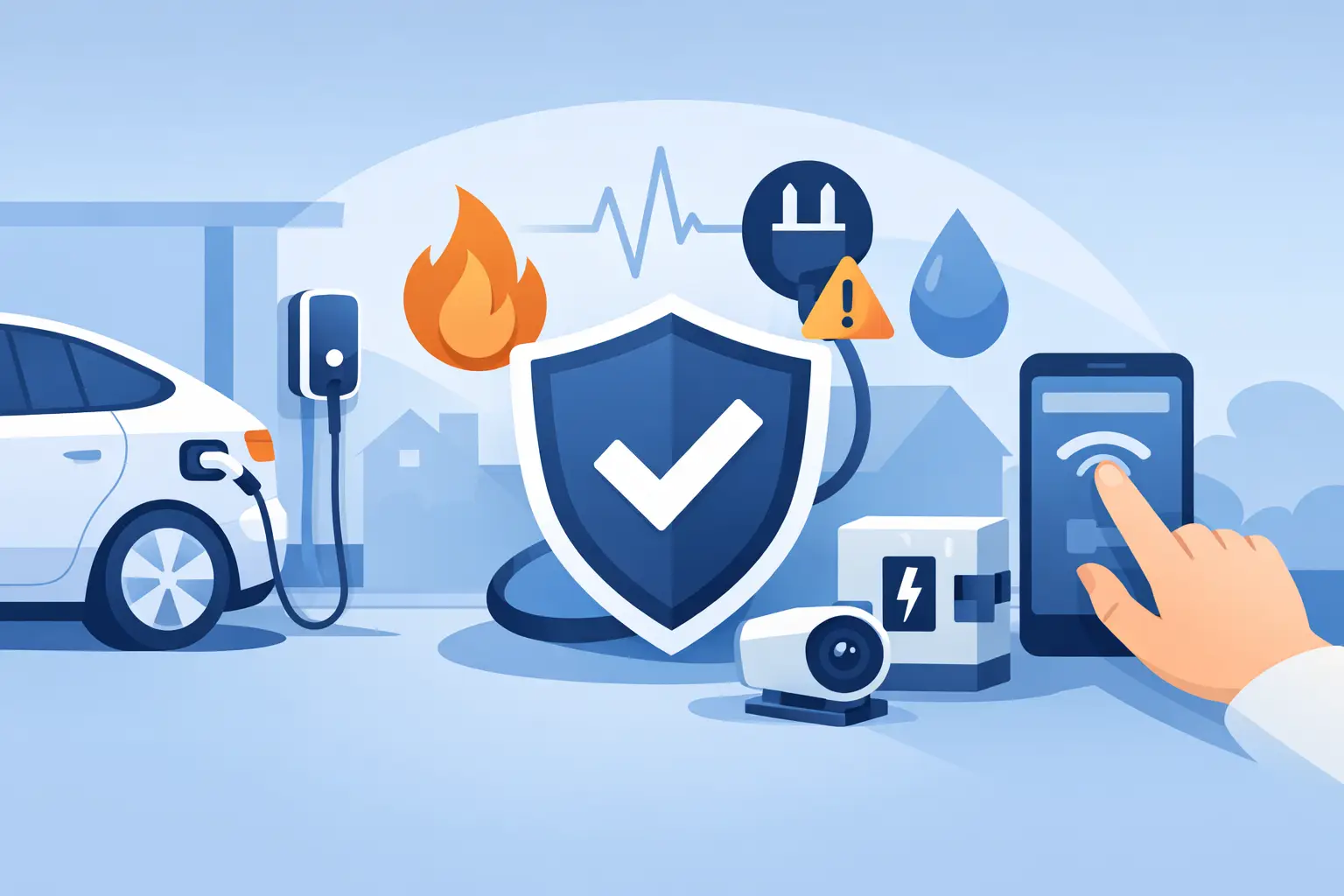
A home EV charger handles more power, for more hours at a time, than many homeowners realize. The best home charger safety features are not just about choosing a well-known charger brand. They include the protections built into the equipment, the condition of your electrical panel, and the quality of the installation behind the wall.
For Santa Rosa and Sonoma County homeowners, a safe charging setup starts with a charger that is properly listed for its intended use and ends with a dedicated circuit installed by a licensed electrician. Here is what deserves your attention before installing a Level 2 charger at home.
Start With a Properly Listed EV Charger
A charger should be listed by a nationally recognized testing laboratory, such as UL or ETL. This confirms that the equipment has been evaluated against applicable electrical safety standards. It is a basic requirement, but it matters because online marketplaces are full of inexpensive chargers with unclear certifications, questionable documentation, or labels that do not match the equipment.
Look for a charger specifically rated for the location where it will be installed. A unit in a dry, attached garage has different exposure than one mounted on an exterior wall, carport, or driveway. Outdoor-rated equipment should have an enclosure designed to resist rain, dust, and temperature changes. A charger that is merely placed under an eave is not automatically protected from wind-driven rain or moisture.
A listed charger does not eliminate the need for correct installation. It simply means the equipment itself has passed a meaningful safety benchmark when used as instructed.
The Best Home Charger Safety Features to Prioritize
Not every feature advertised on an EV charger has the same safety value. App controls and energy reports can be useful, but the protections below have a more direct role in protecting people, vehicles, and homes.
Ground-fault protection
Ground-fault protection helps detect electricity taking an unintended path, including through a person or a wet surface. Modern EV charging equipment commonly includes ground-fault monitoring, and electrical code requirements may also call for GFCI protection at the circuit breaker depending on the equipment and installation details.
This is one area where equipment instructions matter. Adding a GFCI breaker without confirming compatibility can sometimes lead to nuisance tripping with certain chargers. A qualified electrician reviews the charger specifications, local code requirements, and breaker options rather than assuming one solution fits every installation.
Temperature monitoring at the plug or connector
Excess heat is a warning sign of a poor connection, damaged wiring, worn receptacle, or overloaded component. Higher-quality chargers may monitor temperature at the connector or internal components and reduce charging power or stop charging if temperatures rise beyond safe limits.
This protection is especially valuable for plug-in chargers. A receptacle that looks fine from the outside can still have loose internal contacts that create heat during a long charging session. For higher-amperage charging, a hardwired charger often removes the receptacle and plug connection from the equation, reducing one potential point of failure.
Automatic fault detection and shutoff
An EV charger should not energize the connector until it has safely communicated with the vehicle. It should also stop charging when it detects conditions such as a ground fault, abnormal current, internal equipment fault, or damaged connection.
This is a core function of EV charging equipment, not an optional luxury. The charger is designed to control when power is delivered, while the dedicated circuit and breaker provide additional protection if there is an electrical problem upstream.
Weather-resistant construction
For exterior installations, look beyond a general claim that a charger is suitable for outdoor use. The enclosure, cable, connector holster, and mounting hardware all need to hold up through wet winters, summer heat, dust, and daily use.
The charging cable should be protected from being driven over, pinched by a garage door, or left where it creates a trip hazard. A properly mounted holster keeps the connector off the ground and helps prevent moisture and debris from entering the contact area.
Surge protection
A surge can damage sensitive electronics in a vehicle charger, the vehicle itself, or other equipment throughout the home. Some chargers include internal surge protection, but that does not necessarily protect every electrical system in the house.
A whole-home surge protective device installed at the electrical panel can add another layer of protection. Whether it is worthwhile depends on the age of the home, the value of connected electronics, local power conditions, and the existing panel configuration. It is a conversation worth having during an EV charger estimate, particularly when a panel upgrade is already being considered.
The Circuit Is as Important as the Charger
A Level 2 EV charger must be installed on a dedicated circuit. That means the charger is not sharing power with a dryer, water heater, workshop tools, or other large loads. EV charging is considered a continuous load because it can operate for three hours or more, so the circuit must be sized accordingly.
For example, a charger set to deliver 32 amps generally requires a circuit sized for at least 40 amps. A charger delivering 40 amps generally needs a 50-amp circuit. The wiring, breaker, disconnecting means when required, and charger settings all need to agree with one another.
The safe choice is not always the highest charging speed. A smaller charger setting may be the right answer if it reliably charges the vehicle overnight without requiring extensive electrical upgrades. An honest assessment should consider driving habits, the vehicle’s charging capability, available panel capacity, and the home’s other major electrical loads.
Do Not Skip the Panel Capacity Review
Many Sonoma County homes have older electrical panels or panels that have gradually filled up as homeowners added air conditioning, hot tubs, remodeled kitchens, solar equipment, or electric appliances. A charger may physically fit on the panel, but that does not automatically mean the home has enough electrical capacity to support it safely.
A licensed electrician performs a load calculation to determine whether the existing service and panel can handle the added demand. In some cases, the answer is a straightforward new dedicated circuit. In others, the home may need a panel upgrade, service upgrade, or a charger with managed load capabilities.
Load management can be a practical option when a full service upgrade is not immediately necessary. Certain systems can reduce or pause EV charging when the home approaches its electrical capacity, then resume charging when demand drops. It is not the right solution for every property, but it can help homeowners add charging without overloading the service.
Hardwired vs. Plug-In Chargers: A Real Safety Trade-Off
A plug-in charger offers flexibility. It can be easier to replace or take with you if you move, provided the receptacle and circuit are correctly installed. However, the receptacle is another connection point that must carry high current for long periods.
A hardwired charger has fewer connection points and is often preferred for higher-amperage installations. It is permanently connected to the branch circuit, which can reduce the chance of heat buildup at a receptacle. It may also allow higher charging output, depending on the charger and electrical design.
Neither option is automatically safe or unsafe. A correctly installed plug-in charger using a high-quality receptacle can perform well. A hardwired charger is usually the stronger choice when homeowners want higher power, a clean permanent installation, or an exterior setup exposed to regular weather.
Installation Details That Protect Your Home
The best equipment can still become a problem if the installation is rushed. The circuit needs correctly sized copper conductors, properly rated breakers, secure terminations, and a charger setting that matches the circuit rating. Connections must be tightened to manufacturer torque specifications, not simply made tight by hand.
Permitting and inspection also serve a purpose. They provide an additional review that the installation meets the requirements that apply to the property. This is particularly valuable with older panels, detached garages, long wire runs, and homes with existing electrical modifications of uncertain quality.
A professional installer should also explain where the charger will be located, how the cable will be managed, what charging output the home can support, and whether future electrical upgrades could affect the plan. Clear answers before work begins are part of a safe installation.
Choose Safety Over a Bigger Number
The charger with the highest advertised amperage is not automatically the best charger for your home. The right setup is the one that fits your vehicle, your daily driving needs, your panel capacity, and the conditions at the installation location.
For homeowners in Santa Rosa and throughout Sonoma County, APG Electric can evaluate the full electrical picture before recommending a charging solution. A charger should give you confidence each time you plug in, not leave you wondering whether your home’s electrical system is being pushed too hard.