935 Bush Street Santa Rosa, CA 95404
License #998700
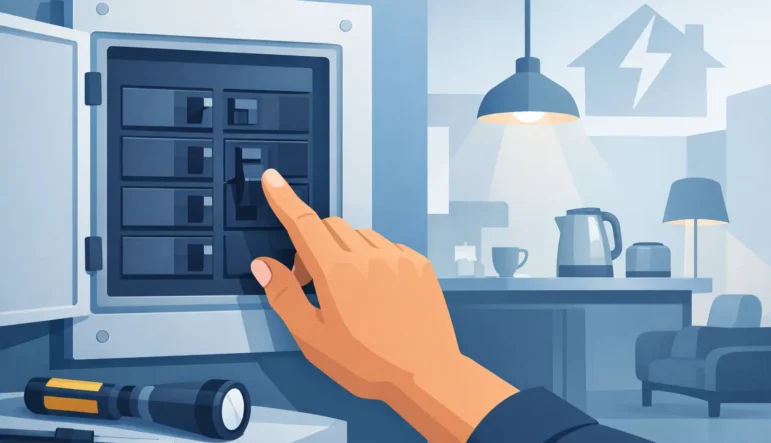
A breaker that trips once while you are running a hair dryer or space heater can be an inconvenience. A breaker that keeps tripping is your electrical system telling you something needs attention. Knowing how to reset tripped breakers safely can restore power to part of your home, but it should never mean ignoring the reason the breaker shut off in the first place.
Circuit breakers are designed to protect your wiring from overheating and reduce the risk of electrical shock or fire. The safe approach is simple: identify the affected circuit, turn off or unplug what was using power, reset the breaker correctly, and pay attention to what happens next.
Your electrical panel may be in the garage, basement, utility room, hallway, or exterior service area. Inside, each breaker controls a different circuit, such as kitchen outlets, bedrooms, lighting, the garage, or a major appliance.
A tripped breaker does not always sit fully in the OFF position. In many panels, its handle rests in a middle position between ON and OFF. Compare it with the other breakers if you are unsure. Some panels also have labels that identify which part of the house each breaker serves, although older homes may have labels that are incomplete or inaccurate.
Before opening the panel door, make sure your hands are dry and the floor around you is dry. Do not remove the panel cover or touch wiring inside the panel. Homeowners can operate breaker handles, but exposed electrical components should only be handled by a licensed electrician.
Resetting a standard residential circuit breaker takes only a moment, but the order matters.
First, turn off lights and unplug devices on the circuit that lost power. If you know a high-demand appliance was running when the power went out, such as a microwave, portable heater, air fryer, vacuum, or hair dryer, unplug it before resetting the breaker. This reduces the load on the circuit when power is restored.
Next, locate the tripped breaker. Push the handle firmly all the way to the OFF position. Even if it appears to be off already, move it fully off before turning it back on. Then push it firmly to ON.
Return to the affected area and check whether power has been restored. Plug in and use devices one at a time rather than turning everything on at once. If the breaker stays on, the issue may have been a temporary overload. If it trips again immediately or shortly afterward, leave it off and arrange for professional diagnosis.
For a double-pole breaker serving 240-volt equipment, such as an electric range, dryer, air conditioner, EV charger, or hot tub, reset both linked handles together. Never try to force one side independently. These circuits supply more power and deserve extra caution when they trip.
A circuit breaker trips because it detects a condition that could damage wiring or equipment. The most common cause is an overload: too many devices are drawing power from the same circuit. This is especially common in older Sonoma County homes, where a single circuit may serve more outlets than a modern household expects.
A portable space heater is a frequent example. It may draw 1,500 watts on its own, leaving little capacity on a circuit already serving lamps, a television, office equipment, or kitchen appliances. Extension cords and power strips do not increase a circuit’s capacity. They only make it easier to plug more items into the same circuit.
A breaker can also trip because of a short circuit or ground fault. A short circuit can occur when damaged wiring, a loose connection, or a failed appliance allows electricity to take an unintended path. A ground fault happens when electricity escapes its intended path to ground, often in damp locations such as kitchens, bathrooms, garages, outdoor areas, or laundry rooms.
Modern homes may also have arc-fault circuit interrupter, or AFCI, breakers. These are designed to detect certain dangerous arcing conditions that ordinary breakers may miss. They can trip because of damaged cords, loose connections, worn outlets, or a problem within a connected device. Although nuisance tripping can occur in some situations, repeated AFCI trips should be evaluated instead of bypassed.
One isolated trip after obvious overuse may be reasonable to reset. For example, a circuit that trips while a portable heater, hair dryer, and bathroom fan are all operating may simply be overloaded. Once those loads are reduced, the breaker may remain on without another problem.
The situation changes if the breaker trips repeatedly, trips with little or nothing plugged in, or will not reset at all. Those symptoms can point to a faulty appliance, damaged cord, loose outlet connection, deteriorated wiring, a failing breaker, or an undersized circuit for the way your home is being used.
Do not keep resetting a breaker to see whether it will hold. Repeated resets can allow a dangerous problem to continue and may make the eventual repair more complicated. A breaker is a safety device, not something to work around.
Leave the breaker off and contact a licensed electrician if you notice burning odors, buzzing or crackling sounds, warmth at the panel or outlet, discoloration, sparks, smoke, or visible damage. These are not normal signs of an overloaded circuit.
You should also call for help if a breaker trips again immediately after you reset it, if lights flicker in multiple rooms, or if the main breaker has tripped. A main breaker issue can affect the entire home and may involve the panel, service equipment, or a broader electrical fault.
Water near electrical equipment is another reason to stop and seek professional help. Do not reset breakers if there has been flooding, a roof leak near wiring, moisture inside the panel, or water intrusion around outlets. Electrical equipment must be assessed before it is energized again.
Homes with older panels, aluminum branch wiring, frequent extension-cord use, or newly added electrical demands may need a more complete evaluation. An EV charger, hot tub, workshop equipment, or major kitchen upgrade can expose capacity limitations that were not noticeable before.
Sometimes a dead outlet is not caused by a tripped breaker at all. It may be protected by a ground-fault circuit interrupter, or GFCI, outlet. These outlets have TEST and RESET buttons and are common in bathrooms, kitchens, garages, laundry areas, crawl spaces, and exterior locations.
If outlets in one of these areas stop working but the breaker is still on, look for a nearby GFCI outlet and press RESET. One GFCI device can protect several downstream outlets, so the reset point may be in an adjacent room, garage, or exterior location.
If the GFCI will not reset, trips repeatedly, or shows signs of damage, do not force it. The device may be detecting a real ground fault, or the outlet itself may have failed.
Never replace a breaker with a larger one just because the existing breaker trips. Breaker size is matched to the wiring and circuit design. Installing a larger breaker on wiring that cannot safely carry the added current can create a serious fire hazard.
Avoid running high-demand appliances through extension cords, especially space heaters, air conditioners, microwaves, or EV charging equipment. Do not tape a breaker in the ON position, hold it on manually, or remove a breaker from the panel. Those actions defeat the protection your home depends on.
It is also wise to avoid treating a recurring trip as a simple inconvenience. If the same circuit repeatedly cannot handle normal household use, the right answer may be a dedicated circuit, an outlet repair, or an electrical panel upgrade. The correct solution depends on the diagnosis, not a guess.
A licensed electrician can determine whether the issue is an overloaded circuit, a failing appliance, a damaged connection, or a panel-related concern. That distinction matters because the repairs are very different. Replacing an outlet will not solve an undersized circuit, and adding a circuit will not correct a damaged appliance cord.
For homeowners adding modern electrical loads, dedicated circuits are often the best path forward. EV chargers, hot tubs, electric dryers, induction ranges, and garage workshop equipment should be planned around your home’s available electrical capacity. In some homes, a panel upgrade creates the room and safety margin needed for those improvements.
APG Electric provides clear, professional troubleshooting for Santa Rosa and Sonoma County homeowners who want answers before committing to a repair. A proper diagnosis protects your home, helps avoid unnecessary work, and gives you a clear recommendation based on the condition of your electrical system.
If a breaker resets once and stays on after you reduce the load, keep an eye on that circuit. If it trips again, treat it as useful information from your home: leave the circuit off, avoid the temptation to keep resetting it, and have the cause checked before a small electrical issue becomes a larger one.
