935 Bush Street Santa Rosa, CA 95404
License #998700
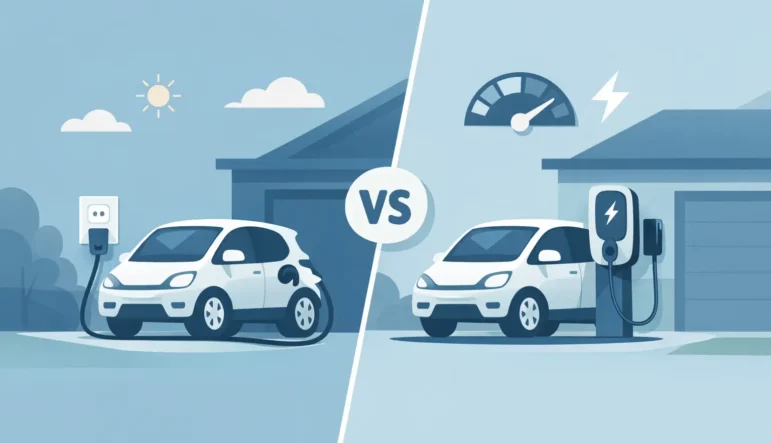
A new EV can make the garage feel like part of your home’s energy system. When homeowners ask about Level one versus Level two charging, they are usually trying to answer a practical question: Will the outlet they already have be enough, or is it time to install dedicated charging equipment?
The right answer depends on how far you drive, how long your vehicle sits at home, your electrical panel’s available capacity, and your plans for the next few years. For many Sonoma County drivers, Level 2 charging is the more convenient long-term solution. But Level 1 has a place, especially for low-mileage driving and temporary use.
Level 1 charging uses standard 120-volt household power. Most EVs include a portable charging cord that can plug into an appropriate grounded outlet, often the same type used for a garage refrigerator or workbench tools.
Charging speed is the trade-off. Level 1 commonly adds about 3 to 5 miles of range per hour. An overnight charge may add enough range for a short commute, but replenishing a mostly depleted battery can take more than a day. That can work well for a plug-in hybrid or a driver who travels only a few miles most days. It becomes less convenient when your schedule changes, guests visit, or you need to leave again after an evening errand.
A standard outlet is not automatically ready for continuous EV charging. Charging places a sustained demand on wiring, receptacles, and connections for hours at a time. Older outlets, damaged cords, loose connections, or circuits shared with other garage equipment can create problems. A licensed electrician can determine whether the circuit is suitable and whether a dedicated 120-volt circuit is the safer choice.
Level 1 is often enough when a vehicle is parked at home for long periods and daily mileage is modest. It can also be a practical starting point while a homeowner evaluates driving habits, waits for a panel upgrade, or plans a larger garage remodel.
It is not necessarily the least expensive option over time if it leaves you relying on public charging more often than expected. Convenience has value, particularly when the vehicle is your primary transportation.
Level 2 charging uses 240-volt power, similar to the electrical service used by many electric dryers, ranges, and other major appliances. It requires a properly designed dedicated circuit and either a hardwired charging station or a suitable receptacle approved for the equipment being installed.
Most Level 2 home chargers add roughly 12 to 40 miles of range per hour, though actual charging speed depends on the charger output, the vehicle’s onboard charging capacity, battery condition, and settings. That difference usually means a vehicle can recharge overnight after normal daily use, giving homeowners a more predictable routine.
For a household with one EV, Level 2 often removes the need to think about charging every day. Plug in when you get home, and the vehicle is ready by morning. For two EVs, long commutes, or frequent weekend trips, a higher-capacity Level 2 setup may be especially worthwhile.
Homeowners often call the wall-mounted unit a charger, but the equipment installed in the garage is more accurately called EV supply equipment. Its job is to communicate safely with the vehicle and deliver the power the electrical system can support.
The unit itself matters, but the circuit behind it matters just as much. A quality installation considers the circuit breaker, wire size, routing, connections, grounding, equipment location, and applicable electrical code requirements. It also accounts for the fact that EV charging is a continuous electrical load, which affects circuit sizing.
A lower-priced unit cannot compensate for an undersized circuit or an installation that overlooks the home’s existing electrical demands. The goal is dependable charging without overloading the system.
The most visible difference is speed. Level 1 is measured in days for a large battery, while Level 2 is often measured in overnight hours. That distinction affects whether charging feels like a background routine or another item to manage.
Cost is more nuanced. Level 1 may have little upfront cost if a suitable dedicated 120-volt outlet already exists. Level 2 requires equipment, a new 240-volt circuit, and professional installation. Costs can rise when the electrical panel is far from the parking location, wiring must travel through finished walls or underground areas, or the home needs a panel upgrade.
Electrical capacity is another key distinction. A Level 2 charger adds a substantial load to the home. Before installation, an electrician should assess the panel and perform a load calculation rather than simply adding a breaker. A 200-amp panel does not automatically mean unlimited capacity, and an older 100-amp panel may or may not support the charger you want alongside air conditioning, electric cooking, a hot tub, or other major loads.
There is also a future-planning question. If you expect to replace a gas range with an electric model, add a heat pump, install a hot tub, or purchase a second EV, it may make sense to plan the electrical work together. In some homes, a panel upgrade or load-management solution is the right way to support electrification without compromising safety.
More amperage is not automatically better. The best charging capacity should match the vehicle, the home’s electrical capacity, and your real schedule.
A driver with a short daily commute may be fully satisfied with a modest Level 2 circuit. A household that drives 80 or 100 miles most days may benefit from faster charging, provided the panel can support it. Your vehicle manual can identify its maximum AC charging rate, which is important because some vehicles cannot use the full output of higher-powered home equipment.
Location also affects the plan. Garage installations are often straightforward, but carports, driveways, detached garages, and outdoor locations need careful attention to weather-rated equipment, trenching, mounting, cable management, and protection from vehicle impact. A clean installation should be convenient to use without leaving a cord stretched across a walkway.
The service panel is the traffic controller for your home’s electricity. Adding an EV charger without understanding the traffic already moving through that panel is not a responsible approach.
An evaluation starts with the home’s existing service size and major electrical loads. It also considers available breaker space, the condition and age of the panel, and any signs that the system needs attention, such as heat damage, corrosion, obsolete equipment, or recurring breaker issues. The result may be simple: install a dedicated circuit. Or it may reveal that a panel replacement, service upgrade, or different charging strategy is the more sensible investment.
Honest recommendations matter here. Not every EV charger installation requires a panel upgrade, and not every older panel should be pushed to its limit. A licensed electrician should explain what the home can safely support, what work is necessary now, and what options will help prevent avoidable costs later.
Portable Level 1 charging cords are useful, but they should not be treated like extension-cord appliances. Avoid extension cords and power strips unless the EV manufacturer specifically provides an approved solution. Do not charge from a worn, loose, warm, or damaged receptacle. If a breaker trips, a plug feels hot, or charging stops unexpectedly, have the circuit inspected rather than repeatedly resetting it.
For Level 2 equipment, professional installation helps protect both the vehicle and the home. APG Electric helps Sonoma County homeowners evaluate their electrical capacity, choose a practical charging setup, and install dedicated EV charging circuits with workmanship built for daily use.
The best setup is the one that fits your driving life and your home’s electrical system without guesswork. Whether Level 1 meets your needs for now or Level 2 makes daily ownership easier, start with a clear assessment of the circuit, panel, and equipment before you plug in.
