935 Bush Street Santa Rosa, CA 95404
License #998700
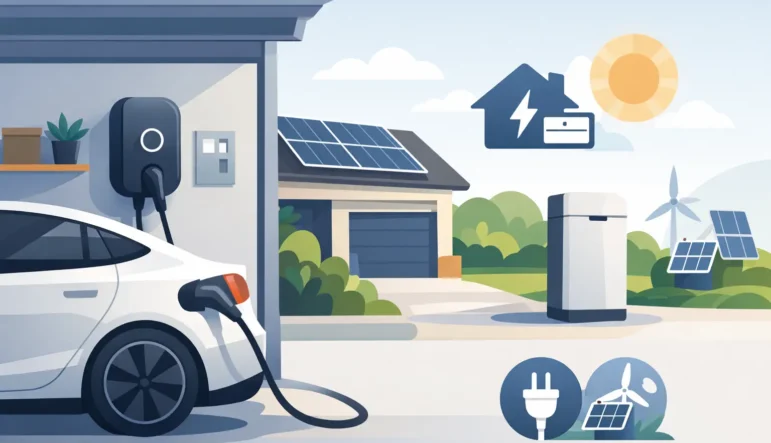
An EV is most convenient when it starts each morning with the range you need. A home charging station turns charging into an overnight routine instead of another stop on your schedule. But the charger itself is only part of the project. Your electrical panel, available capacity, parking layout, and installation method all determine whether the finished setup is safe, reliable, and worth the investment.
For homeowners in Santa Rosa and throughout Sonoma County, a professional evaluation is the best place to start. It identifies what your home can support now, what upgrades may be needed, and which charging option fits how you actually drive.
Most EVs include a portable charging cord that can plug into a standard 120-volt outlet. This is often called Level 1 charging. It can be useful for low-mileage drivers, plug-in hybrids, or temporary charging, but it adds range slowly. Depending on the vehicle, it may take more than a full day to recharge a larger battery.
A dedicated Level 2 home charging station uses a 240-volt circuit, similar to the electrical supply used for a dryer or electric range. It can add substantially more range per hour, allowing many drivers to recharge overnight. The exact rate depends on the vehicle, the charger, and the circuit size, but the practical benefit is simple: you can plug in when you get home and leave with a full battery when you need it.
Level 2 is not automatically the right answer for every household. If you drive only a few miles each day and have reliable time to charge, Level 1 may meet your needs. A licensed electrician can help you avoid paying for more charging capacity than your driving habits require while still planning for future needs.
The best charger is not always the model with the highest advertised output. Your EV has a maximum charging rate, and your home’s electrical system has limits of its own. Installing a charger that exceeds either one will not make your car charge faster.
Start with your vehicle. Some EVs can accept higher Level 2 charging rates than others. Then consider your daily mileage, when you are usually home, and whether another EV may be added later. A household that drives 30 miles a day has different needs than one with two electric vehicles, frequent long trips, or a long commute over Highway 101.
You will also choose between a hardwired charger and a plug-in unit. A hardwired charger is connected directly to its dedicated circuit. It is often a clean, durable choice for a permanent installation and may support higher-output configurations when appropriate. A plug-in charger uses a correctly installed 240-volt receptacle. It can be easier to replace or take with you, but the receptacle, plug type, and circuit must be selected and installed for the intended continuous load.
Smart charging features can be helpful, but they are not essential for everyone. Some stations allow scheduling, energy monitoring, or load sharing between two chargers. These features make sense when they solve a real household need. They should not distract from the fundamentals: a properly sized circuit, quality components, correct installation, and code-compliant protection.
A charger is a continuous electrical load, meaning it can operate for several hours at a time. That is why a home charging station needs more than an open breaker space. The electrician must determine whether your service and panel have enough capacity for the additional demand.
This process is called a load calculation. It accounts for the electrical loads already in your home, including HVAC equipment, electric appliances, lighting, laundry, hot tubs, and other major circuits. In Sonoma County, this matters even more as homes add heat pumps, induction ranges, battery systems, and other electrification upgrades.
An older panel may still have empty breaker spaces but lack the capacity for EV charging. In other cases, the panel may have adequate service capacity but be physically full. The solution could be as straightforward as adding a subpanel or making room in the existing panel. It could also call for a panel upgrade, depending on the home and its long-term plans.
A trustworthy recommendation should explain the reason for any upgrade. Not every EV charger installation requires a new panel, and a professional electrician should not treat a panel replacement as automatic. At the same time, forcing a high-demand charger onto an overloaded system is not a safe shortcut.
For some homes, energy management equipment can monitor total electrical use and reduce or pause EV charging when the house is approaching its capacity. This can be a practical alternative to a larger service upgrade in the right situation.
There are trade-offs. Load management adds equipment and relies on a charging system designed to work with it. It may also reduce charging speed during periods of heavy household use. Still, for homeowners who need predictable overnight charging rather than maximum possible output, it can be a cost-conscious option worth discussing.
The ideal location is usually where the charging cable can reach the vehicle without stretching across a walkway, driveway, or garage door path. For many homes, that means mounting the station on a garage wall near the vehicle’s charging port. Others need an exterior installation near a driveway or carport.
Distance from the electrical panel has a real effect on cost. A charger located across the house, on a detached garage, or at the end of a long driveway may require more conduit, wire, trenching, and labor. Exterior work also requires weather-rated equipment and careful routing to protect wiring from physical damage.
Think about how you park, not just where the car sits today. If you may change vehicles, rearrange the garage, or add a second EV, placing the charger where the cable can comfortably serve more than one parking position can prevent a frustrating relocation later.
A home charging station is not a typical appliance installation. It involves a new 240-volt circuit, electrical protection requirements, conductor sizing, grounding, and local permit rules. California electrical requirements and local inspection processes are there to help prevent overheating, damaged equipment, shock hazards, and avoidable fire risks.
Professional installation also matters for warranty and insurance documentation. Many charger manufacturers specify that their equipment must be installed by a qualified electrician. If a problem develops later, documented permit and installation records provide useful proof that the work was completed correctly.
A qualified electrician should inspect the panel, verify service capacity, identify the appropriate circuit size, review the installation path, and explain the options before work begins. The work should be clean as well as safe, with properly supported conduit, labeled breakers, quality connections, and a charger placed at a practical height and location.
A clear estimate should be based on your actual home, not just a flat price quoted without a site review. The final cost can vary with panel capacity, charger location, wire run length, whether walls need to be opened, outdoor conditions, permitting, and any needed panel or service work.
Before requesting an estimate, it helps to have your EV model, preferred charger model if you have one, photos of the electrical panel, and a few photos of the parking area. You do not need to know electrical terminology. Those details simply help the electrician assess the project more efficiently.
During the visit, ask what charging rate the proposed circuit will support and whether that rate matches your vehicle. Ask whether the panel has room and capacity for future electrical upgrades. You should also understand whether the quote includes permit coordination, materials, patching if needed, and any work required to bring the installation to current code.
EV charging is often the first major electrical upgrade a homeowner considers, but it rarely stays the only one. A panel that is adequate today may be tested later by a heat pump, electric water heater, induction cooking, solar equipment, or a second EV.
That does not mean every project needs the largest possible upgrade. It means the installation should be planned with an honest view of your household’s likely direction. APG Electric helps homeowners weigh charging needs, available electrical capacity, and practical upgrade paths without pushing work that the home does not need.
The right home charging setup should feel unremarkable after installation: park, plug in, and get on with your evening. A careful electrical assessment is what makes that everyday convenience dependable for years to come.
