
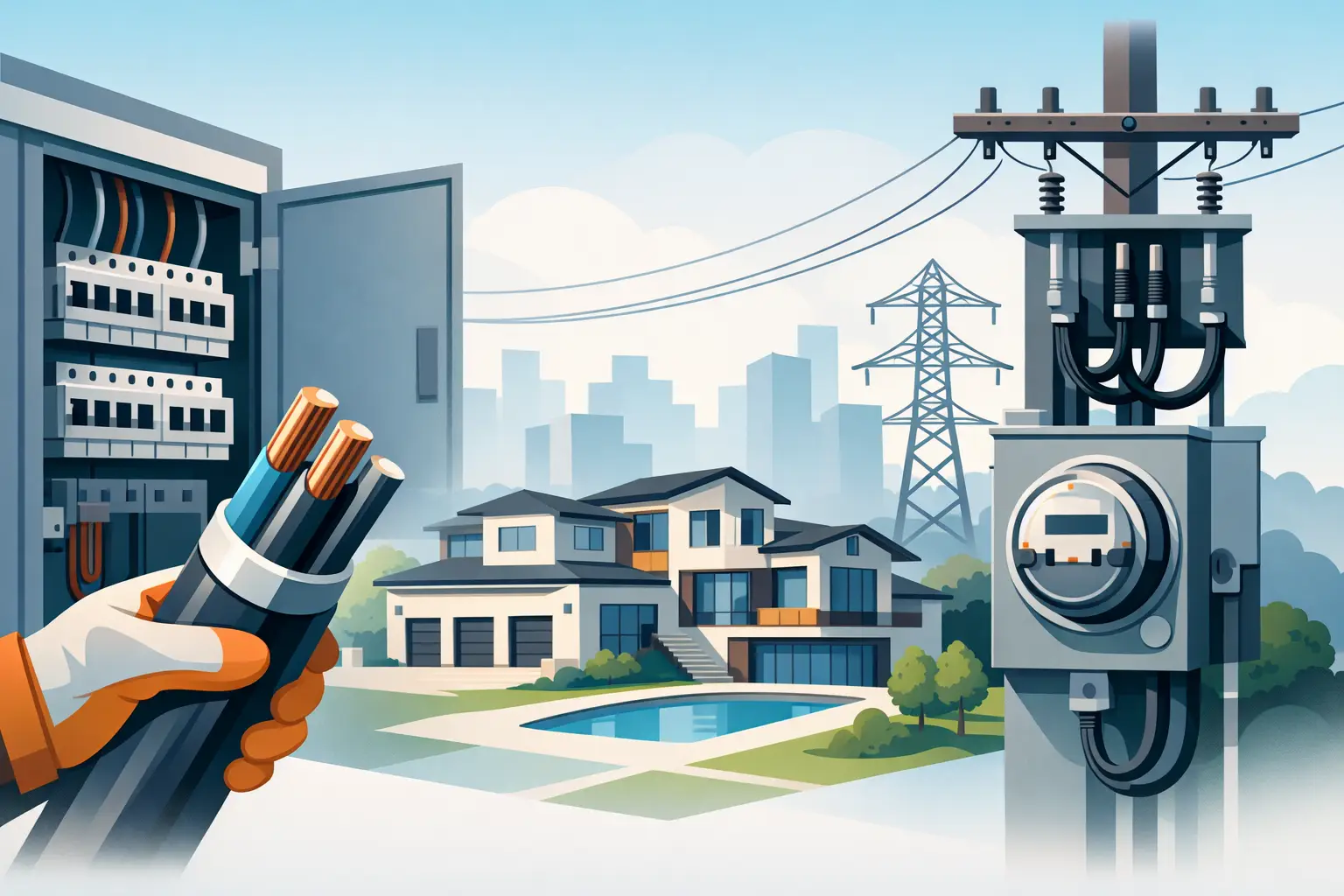
A homeowner usually asks what is the largest residential electrical service when they are adding something big – a second EV charger, an all-electric kitchen, a hot tub, a large HVAC upgrade, or an accessory dwelling unit. It is a fair question, but the answer is not one number that fits every house. In most homes, 200 amps is the modern standard, 400 amps is typically the largest common residential service, and anything beyond that starts to become a special-case design rather than a normal single-family setup.
What is the largest residential electrical service in most homes?
For the average single-family home, the largest residential electrical service you will commonly see is 400 amps. In practice, that may be installed as a 400-amp service feeding one or more distribution panels, depending on the home’s layout and the utility’s requirements.
That does not mean every large house needs 400 amps. Many homes with substantial electrical loads still operate safely and efficiently on 200 amps, especially if the loads are calculated correctly and major appliances are not all running at full demand at the same time. A bigger number sounds better, but residential electrical design is about actual load, not guesswork.
There are homes with 600-amp or larger services, but those are uncommon and usually tied to luxury estates, large accessory structures, extensive mechanical systems, or unusual site conditions. Once you get into that range, utility coordination, equipment layout, service entrance design, and cost all become more complex.
The service sizes most homeowners will actually encounter
Older homes in Sonoma County may still have 60-amp or 100-amp service, especially if they have not had a meaningful electrical upgrade in decades. Those homes were built for a very different load profile – fewer large appliances, no EV charging, less air conditioning, and far fewer electronics.
Today, 100 amps is often considered the minimum acceptable size for a smaller home, while 200 amps is the most common target for upgrades. It gives homeowners room for modern living without immediately running into capacity concerns.
A 400-amp service usually enters the conversation when a property has some combination of a large square footage, multiple HVAC systems, electric water heating, induction cooking, EV charging, a hot tub, shop equipment, or an ADU. Even then, the right answer depends on a formal load calculation, not just a wish list.
Why 200 amps is still the standard
A properly designed 200-amp service supports a lot more than many homeowners expect. If the home uses a mix of gas and electric appliances, or if loads are managed intelligently, 200 amps can handle everyday use comfortably.
That matters because a full jump to 400 amps is not just a panel swap. It can involve meter upgrades, service entrance changes, utility approval, larger conductors, new grounding and bonding work, and sometimes more invasive modifications to the home.
When 400 amps makes sense
Four hundred amps starts to make sense when the home is going heavily electric and staying there for the long term. Think two EV chargers, heat pump HVAC, heat pump water heating, electric dryer, electric range, pool or hot tub equipment, and a detached structure with meaningful power demand.
It can also make sense in larger homes where capacity planning matters now, not five remodels from now. If a homeowner already knows more electric loads are coming, installing the right service once can be more cost-effective than stacking upgrades.
Service size is not the same thing as panel size
This is where a lot of confusion starts. Homeowners often use the words service and panel interchangeably, but they are not the same.
Electrical service refers to the utility-fed capacity coming into the home. The panel is the equipment that distributes that power to branch circuits throughout the house. A home can have more than one panel, especially with a 400-amp service. In some cases, what people call a 400-amp panel is really a 400-amp service with two 200-amp distribution sections.
That distinction matters because adding a larger panel alone does not automatically give the home a larger electrical service. The upstream equipment and utility connection have to support it.
What determines whether a home can go bigger?
The biggest factor is load calculation. A licensed electrician calculates the home’s expected electrical demand based on square footage, fixed appliances, heating and cooling equipment, cooking equipment, laundry, EV charging, and other major loads. Code allows for demand factors because not everything runs at full capacity at once, but those rules have to be applied correctly.
The second factor is utility capability. Even if a homeowner wants a larger service, the local utility has to approve and support the service configuration. Metering, transformer capacity, service lateral or overhead service details, and local standards all affect what is possible.
The third factor is the house itself. Some homes need substantial electrical reworking to accept a larger service safely. The panel location, conductor routing, grounding system, and existing condition of the electrical infrastructure all shape the scope of work.
Bigger is not always better
There is a natural tendency to think, “If I might need more later, why not just go as large as possible now?” Sometimes that is smart planning. Sometimes it is an expensive overbuild.
A larger service can increase equipment cost, labor, permitting complexity, and utility coordination time. It may also require more wall space and create a more involved installation. If a 200-amp service with properly planned circuits covers the home’s needs with room to spare, going to 400 amps may not deliver much practical value.
On the other hand, under-sizing a service creates frustration. Breakers trip, future projects get harder, and homeowners end up paying twice. The right approach is to size the service for the house you have and the upgrades you realistically plan to make.
Common situations that trigger a service upgrade
The question of what is the largest residential electrical service usually comes up when a home is changing, not when it is standing still. In our experience, homeowners start asking when they are electrifying appliances, remodeling a kitchen, adding air conditioning, installing EV charging, or preparing for a hot tub.
An older 100-amp home can run out of room quickly once those loads are added. Even if the panel still has a few breaker spaces, the actual service capacity may be the limiting factor. That is why panel appearance alone never tells the whole story.
A good electrician looks at both present demand and likely future use. If a homeowner in Santa Rosa is replacing a gas furnace with a heat pump this year and plans to add an EV charger next year, that should be part of the recommendation from the beginning.
Residential limits are practical, not just theoretical
Technically, very large residential services exist. Practically, most homeowners should think in terms of 100, 200, and 400 amps. Those are the service sizes that come up most often in real residential projects.
Once a property goes beyond 400 amps, the project usually becomes less about standard home service and more about custom electrical infrastructure. That does not make it wrong. It just means the design, cost, and approval process become much more specialized.
For most households, the better question is not “What is the absolute largest service available?” It is “What service size gives my home safe, reliable capacity without paying for more than I will use?”
How to know what your home needs
If your home is older, your lights dim when large appliances start, your panel is full, or you are planning major additions like EV charging or a hot tub, it is worth having the service evaluated. A licensed residential electrician can inspect the existing equipment, perform a load calculation, and explain whether you need a simple panel replacement, a full service upgrade, or no upgrade at all.
That kind of honest assessment matters. Homeowners should not be pushed into the biggest upgrade on the menu just because bigger sounds safer. The right recommendation is the one that matches the home, the code requirements, and the way you actually live.
At APG Electric Co., that is the standard we believe in – clear answers, careful workmanship, and recommendations that make sense for the property, not just the invoice.
If you are wondering whether your current setup is enough for what comes next, the best next step is not guessing at amp numbers. It is getting a clear load-based answer before your next project forces the issue.